
With the UK car market set to suffer from the EV revolution and record-high fuel prices, many manufacturers are scrambling to keep pace. This month, we explore the challenges faced by the BLMC and Nissan Qashqai. We also look at the impact of the recent shortage on private sales.
So, what is the future of the UK car market? This article examines the latest trends and developments in the industry, as well as how the automotive sector can address its current challenges.
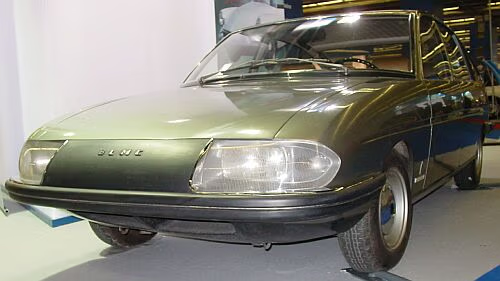
BLMC’s struggle to modernise
During the 1970s, the British Leyland Motor Company (BLMC) was the dominant player in the UK car market. However, it suffered from a decline in model appeal and lost 40% of the market in 1971.
Instead of providing colourful models, the company offered cars with blander styles and duller colours. As a result, the company’s profits were hit, and investment plans were put on hold.
The Barber boom had hit British Leyland’s automotive industry. Production at the Cowley factory was halted in 1971. Production at Longbridge moved to another plant, whereas production of the ADO16 began at Cowley.
Eventually, production at Cowley was discontinued and replaced by the Morris Marina. The Mini’s demand meant that a new factory was needed, and BLMC was unable to make enough of them.
British Govt Invested Funds In BLMC
The British government supported BLMC with funds to modernize its car manufacturing plants. The company produced a variety of cars, engines, transmissions, and parts.
At the time, the company owned fourteen marques, some familiar to owners, while others have faded into automotive history. Among these brands are Alvis, Austin Healey, Daimler, Jaguar, Lanchester, Land Rover, Morris, Standard, and Vanden Plas.
In December 1974, BLMC sought government assistance to revive its business. Despite BLMC’s precarious financial situation, the company continued to sell Minis at a steady pace. The company celebrated its three million Mini sales in October 1972.
Its personality compensated for its shortcomings, and the Mini became one of the few BLMC products to sell in significant quantities for a long time.
Global Financial Crisis 2008
The global financial crisis of 2008 had a profoundly detrimental impact on the UK’s car manufacturing industry. As a result, domestic firms could not compete in the market and were hollowed out. Even though foreign firms acquired Jaguar and Land Rover in 2008, they were unable to modernise the car market. Ultimately, BLMC has failed to modernise the UK car market.
The UK car industry has suffered several setbacks since the launch of the Mini in 1959. The car industry had suffered a dismal year for years, and the Honda factory in Swindon closed last July, removing a significant chunk of the country’s output.
Modernised manufacturing and streamlined production processes are crucial to the automotive industry’s survival. The current situation has made it more challenging to meet demand.
During the 1980s, foreign car manufacturers continued to gain a share in the UK car market. In particular, Fiat, Volvo, and Renault continued to become popular in the UK. BLMC also lost out to continental rivals, such as Volkswagen and Fiat.
However, despite the difficulties, a few cars managed to reach the top of the world’s sales charts. And a decade later, the company would be left with a bleak future.
EV revolution
Although the EV revolution has been a slow start in the UK, it is now showing signs of a resurgence. In early 2015, there were 8,000 electric cars in Greater London alone—8% fewer than the target set by the former mayor six years prior.
The UK is also a leader in electromobility in Europe, leading the way in developing fast-charging infrastructure and supplying the best-selling EV, the Nissan Leaf. In 2011, the government introduced the plug-in car grant, which gave owners of the vehicles up to EUR6,000 each and exempted them from the congestion charge in London.
The UK government has committed to speeding up the EV revolution in the car market by investing in charging infrastructure and creating incentives to encourage people to buy EVs. In March alone, battery electric vehicles sold more than 40,000 units in the UK, surpassing the sales of any other month.
This figure exceeds the number of new cars sold in the past 24 years. This trend is likely to continue, with the government working with stakeholders to accelerate demand and create the conditions that will encourage EVs to compete in the car market.
The advantages of EVs over petrol cars are apparent.
Aside from being cleaner, an electric car is quieter, has sharper braking, and accelerates much faster. Some drivers even describe their EVs as ‘blisteringly fast – and that’s saying something. However, while the benefits of an EV are apparent, it remains challenging to convince everyone of the advantages of owning an electric vehicle.
The UK is on the brink of falling behind European countries with more attractive incentive schemes for buying electric vehicles. While the incentives are encouraging, a lack of public charging infrastructure could stall the growth of the EV market.
The availability of charging infrastructure and the affordability of a public network is essential to ensuring that more drivers switch to electric vehicles. The SMMT has called for an independent regulator to oversee the rapid expansion of the UK’s charging infrastructure.
Another major factor is a ban on selling new petrol and diesel cars in the UK. As part of a government initiative to combat climate change, the government has set a deadline of 2030 for phasing out conventional petrol and diesel cars from the road.
In the short to medium term, the government could introduce a national road pricing scheme to offset the lost revenue from road taxes. As the 2030 deadline draws closer, the EV revolution in the UK car market will continue.
With the government’s target of zero emissions by 2050, electric vehicles will play a crucial role in achieving this goal. While the road to complete electrification is long, 2020 marks a significant leap for the industry. The year 2021 is set to be an even bigger game.
In the UK, sales of pure petrol and diesel vehicles are expected to be down by over half a million units. It will be interesting to see how this industry grows over the coming years.
Nissan Qashqai
The Nissan Qashqai is a compact crossover launched in the UK in 2006. It is manufactured in the Sunderland plant of Nissan Motor Manufacturing UK in Tyne and Wear, United Kingdom.
Its design was developed by Nissan Design Europe in London, with Nissan Technical Centre Europe in Cranfield, Bedfordshire, providing its engineering team with the expertise to produce a car with a distinctive look.
As of June, the company had sold more than 10,000 new cars in Europe, with the UK accounting for 2,763. Despite a global chip shortage, Nissan remains confident that this demand is sustainable, as the new Qashqai is expected to be available in Europe by summer 2021.
Sales of the new Qashqai in the UK fell 32 per cent in the first quarter of 2018, with the car accounting for just under half of the new Nissans sold that month. This is a good start for the car manufacturer, now in sixth place in the UK’s segment.
In the UK, the Nissan Qashqai has become the best-selling car and is one of the best-selling SUVs in the country. More than seventy per cent of Nissan Qashqai vehicles are exported to Europe. Nissan is also proud that its British workforce has grown and can now produce an excellent quality car.
Nissan Motor (GB) managing director Andrew Humberstone said that the Qashqai is a “vote of confidence” for the UK car market.
The Nissan Qashqai is a world car initially designed in the UK. It is a crossover that was sold worldwide, primarily focusing on the SUV market. Initially, the Qashqai felt industrial, but this changed with the release of the new model.
Additionally, the Qashqai is well-equipped. I bought a Nissan Qashqai test car with a mild hybrid engine, 17-inch alloy wheels, dual-zone automatic air conditioning, and an eight-inch Nissan Connect display.
The Nissan Qashqai is a family car, crossover, and executive model. The Qashqai boasts several innovative features that make it an excellent choice for buyers seeking a high-quality vehicle. It even features autonomous driving and wireless CarPlay capabilities.
The Qashqai is now the best-selling car in the UK. Other top sellers include the Ford Puma and the Mini hatchback. The Vauxhall Corsa is another good option, although it may not be the best choice in India.
The Nissan Qashqai is Nissan’s first car in the UK car market and is now the most popular compact family SUV on sale in the UK. It features a higher ride height, more space, and green powertrains.
Nissan also has a factory in Sunderland that is currently producing the Qashqai. It has a top speed of 128mph. It has been in production since 2007 and is expected to hit showrooms in the summer.
