
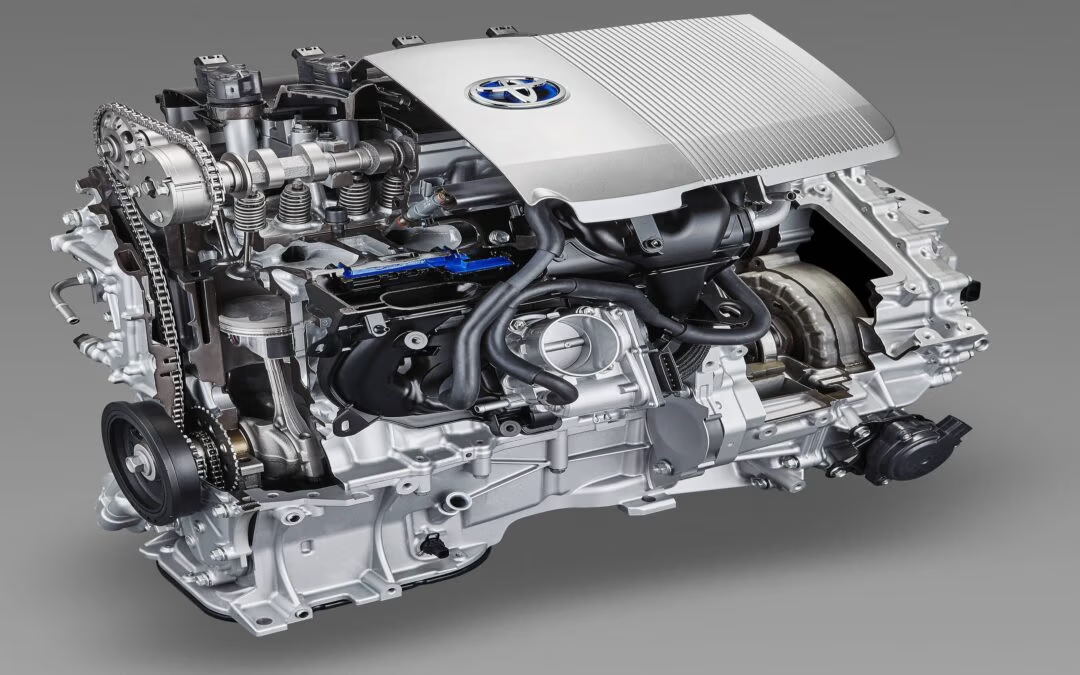
If you’re interested in the history of car engines, then this article is for you. It covers topics ranging from the Benz Patent-Motorwagen to the Atkinson cycle, to the modern-day SKYACTIV-X engine. Read on to learn more about the evolution of car engines and how they have changed our lives.
Benz Patent-Motorwagen
The Benz Patent-Motorwagen is one of the first automobiles, whose engine evolved over time. It was designed by Carl Benz, a German automobile manufacturer, and was first manufactured in 1888. Initially, Benz was reluctant to begin production of his patent motorwagen. Testing was limited to a yard and road around his workshop. Even so, most people assumed that Benz would be the first motorist. But in fact, Bertha Benz was the first to drive a car.
The patent describes the engine, the cooling system, the starting mechanism, and the drive system. A leather belt connected the engine to the pulley, which in turn drove the rear axle via chains. In order to start and stop the engine, a lever had to be pulled.
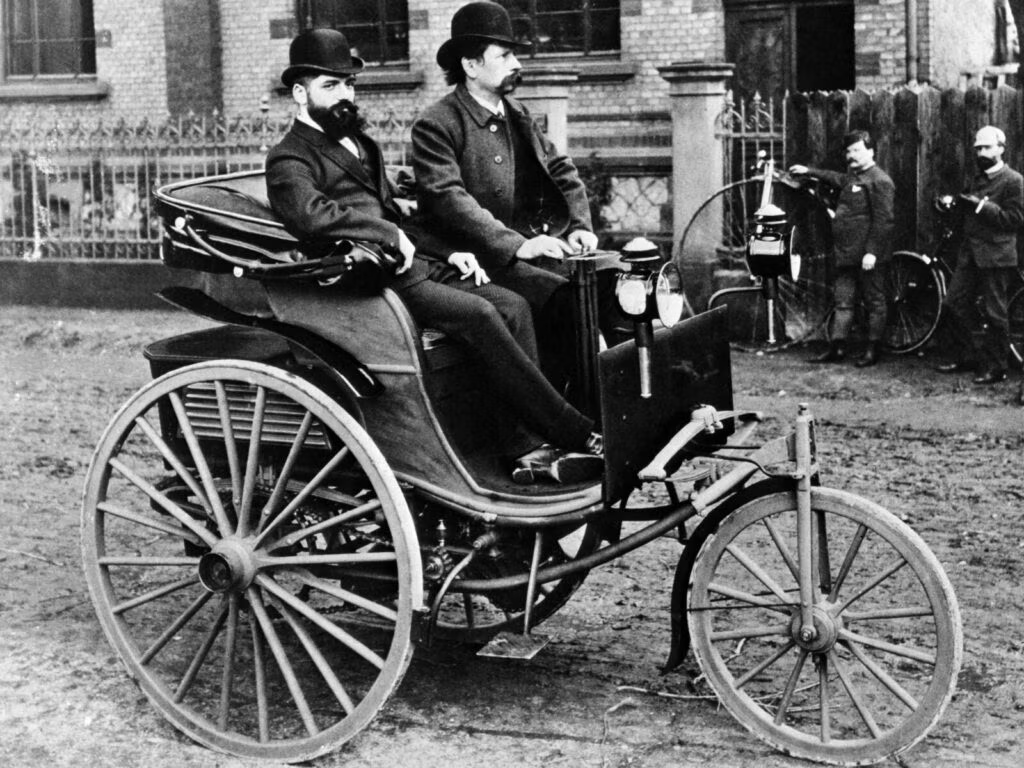
The engine of the Patentwagen was an ingenious invention, and it has since influenced engine design. It was capable of producing 1.1 kW. A number of different Benz patent motorwagen models were developed over the years. Many of them have been reproduced and exhibited in museums worldwide.
The Benz Patent-Motorwagen was first patented in 1886. It was the first automobile with an internal combustion engine. At the time, it cost about 600 German marks, which is equivalent to about 150 US dollars. Benz focused his attention on the motorized vehicle after developing a gasoline-powered two-stroke piston engine in 1873. However, he also continued his career in stationary engines.
A few years later, a company named Daimler purchased the rights to a Daimler patent, and the Benz Patent-Motorwagen had been developed.
Atkinson cycle engine
The Atkinson cycle is a common form of combustion that is efficient for many types of cars. This engine design has the advantage of a short compression stroke. This means that the engine will be less likely to experience a loss of energy during the suction process. In addition, the Atkinson cycle does not require a supercharger. In fact, it may save as much as 15-20 percent of fuel.
It is important to note that this engine design uses variable valve timing. This design allows the engine to produce more power without increasing its weight. It also allows it to achieve more power at lower speeds. The Atkinson cycle engine evolved from its ancestor, the Otto cycle. Modern cars are equipped with hybrid engines that use the Atkinson cycle.
In 1882, British scientist James Atkinson invented the first car engine. However, this design was not cost-effective and did not become widely used. The complex mechanical linkages made it difficult to mass produce. Despite its limitations, the Atkinson cycle is now making a comeback thanks to fuel efficiency.
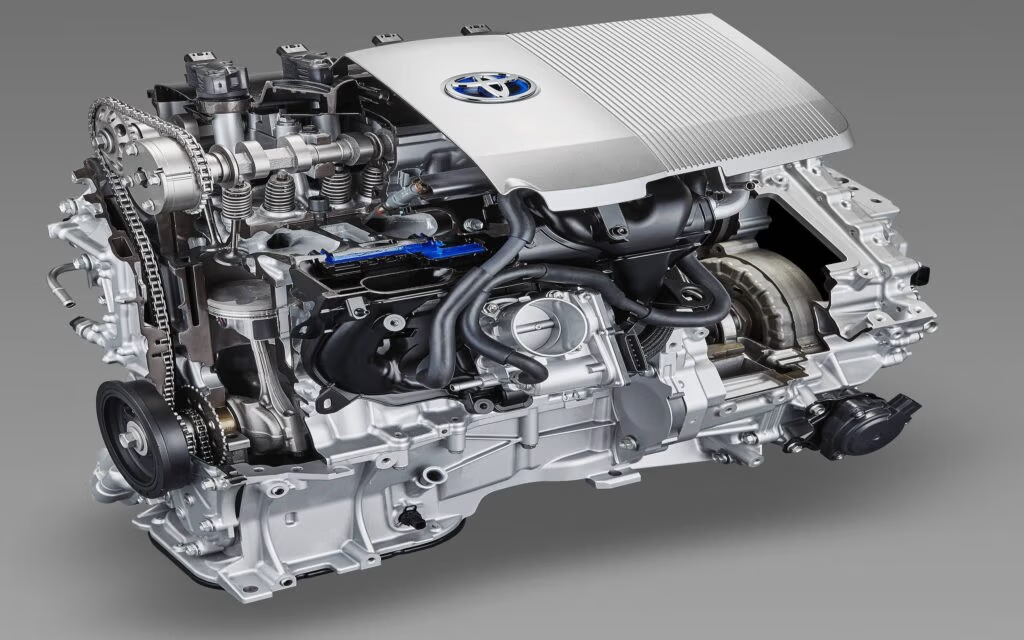
Toyota engineers discovered that the Atkinson cycle engine could save fuel and developed it into a non-mechanical version. This new technology used hydraulics to regulate the position of the camshaft and alter the timing of the intake valves. Toyota’s hybrid models all use this engine in their hybrid versions, ensuring that the engine is fuel-efficient at any speed.
Because of its high compression ratio and increased expansion, the Atkinson cycle engine is great for hybrid vehicles. The electric motor can compensate for the loss of power. Additionally, the Atkinson cycle engine is better for fuel efficiency than its predecessors, which is beneficial for those looking to minimize their environmental impact.
Diesel engine
A diesel engine has many advantages over its gasoline counterpart. The compression ratio is higher and it’s much more efficient. It also has less stoichiometric leaning, which means it produces more power under a lean load. Additionally, it has a lower heat loss and less chance of overheating, making it ideal for many applications.
A diesel engine evolved from a steam engine, which was largely dependent on coal. The industrial revolution changed this, and many professions switched from manual labor to mechanical work. This paved the way for many new developments, including the diesel engine. A diesel engine is based on a two-stroke cycle, and is considered the first modern car engine.
Modern diesel engines have an electronic governor that regulates engine speed. Early diesel engines injected fuel using compressed air. The compressed air forced the fuel into the engine through a nozzle. This technique allows for more fuel to be injected and makes the engine quieter and more efficient. However, the mechanically governed fuel injection systems tended to be large and bulky, limiting the power output.
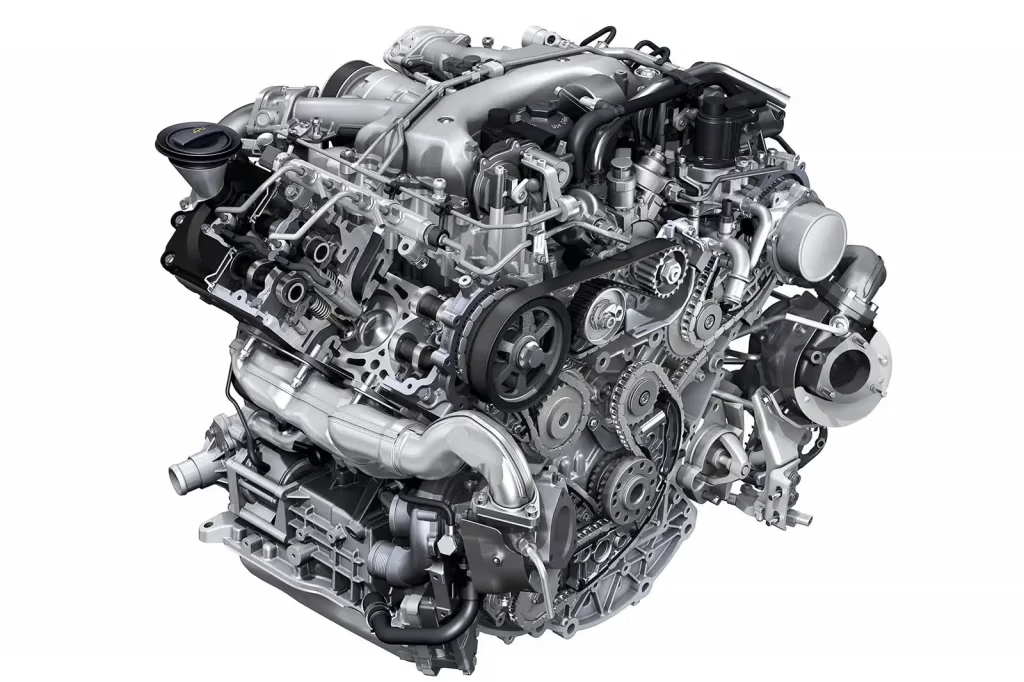
In the 1920s, the first passenger car powered by a diesel engine was introduced. General Motors’ diesel division later became Detroit Diesel. The same year, Clessie Cummins receives a patent for a fuel-feeding and injection apparatus. In addition, the Jacobs Manufacturing Company develops a diesel compression braking system. By the end of the 20th century, diesel engines are responsible for 95% of all medium and large-duty trucks on the road. Their popularity also includes marine applications and the construction industry.
A diesel engine is much more efficient than a gasoline engine. Diesel’s combustion process produces very little carbon monoxide, as it burns fuel in excess of air. However, it does produce black soot from the exhaust. This is the result of unburned carbon compounds in the exhaust. Black soot is often a sign of a worn injector or a faulty engine management system.
The Mazda SKYACTIV-X car engine is an evolution in car engines. This engine has a super-high compression ratio and uses a lean air-to-fuel mixture. This fuel combustion method works in high-pressure and high-temperature conditions. A spark is used to ignite only a small amount of fuel and it is then combusted under high pressure, much like a diesel engine. The engine also uses a type of combustion process known as homogeneous charge compression ignition.
SKYACTIV-X engine
The Skyactiv-X engine is also designed to work in vehicles with electrification. It will burn petrol more efficiently while emitting less harmful emissions. The new car engine will be available in 2022 or 2023. Mazda is also working on a new large-vehicle architecture to accommodate the larger Skyactiv-X engine.
The SKYACTIV-X engine was developed to combine the advantages of gasoline and diesel engines. It works on the same principle as diesel engines, but uses a new technology called SPCCI. It uses regular gasoline but compresses the air-fuel mixture very tightly, producing a lean mixture. The resulting mixture burns at a much higher temperature and higher pressure than conventional engines.
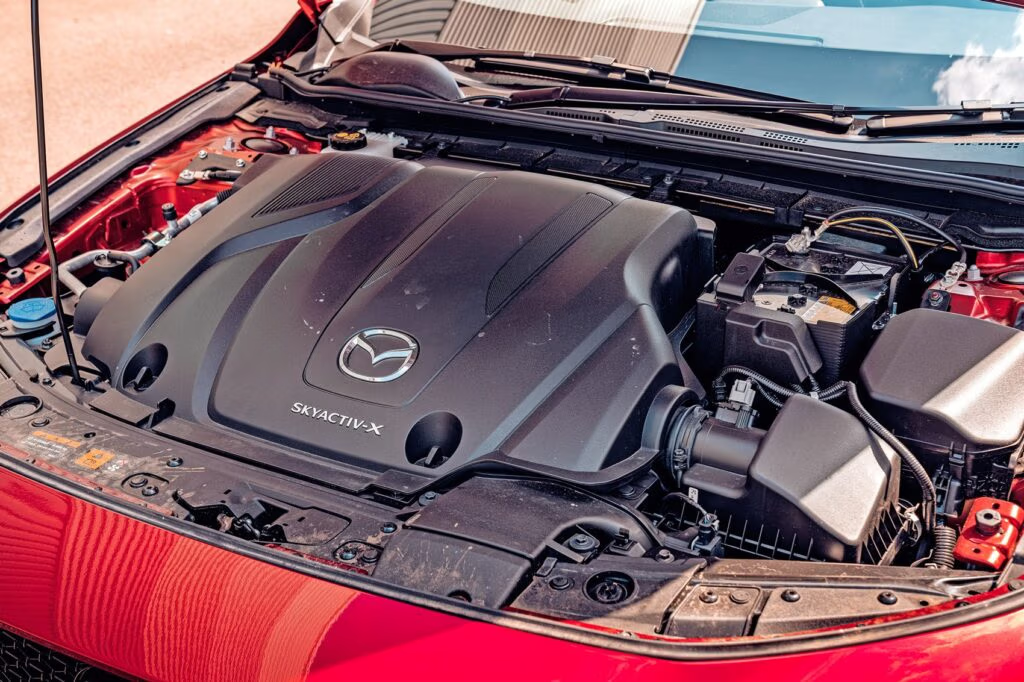
Mazda says the SKYACTIV-X engine will improve fuel efficiency by 20-30 percent over the existing gasoline engine. It is designed for real-world efficiency and is mated to a six-speed manual transmission. The engine feels similar to a turbodiesel engine, yet revs like a gasoline engine. Moreover, the Mazda SKYACTIV-X engine is easy to drive and does not require drivers to re-learn how to drive a gas-powered vehicle.
The Mazda Skyactiv-X car engine is a hybrid of several technologies developed over the past three decades by Mazda. The Mazda Skyactiv-X engine is one of the first cars to feature a compression-ignition engine. The engine uses a spark plug to start the combustion process and a pressure rise from the flame kernel triggers compression ignition in the rest of the cylinder. This process allows the SKYACTIV-X engine to run at air/fuel ratios exceeding 30:1.
Mazda’s SKYACTIV-G engine
The SKYACTIV-G engine evolution continues as Mazda develops a new turbocharged variant. This new version is able to deliver the same power while offering significantly higher gas mileage. To achieve this, Mazda engineers have gone above and beyond to improve the engine’s efficiency under heavy workloads. One notable feature is the cooled EGR module. This helps maintain cool internal temperatures and prevents fuel enrichment.
Mazda’s next-generation platform was also introduced at a technology forum, and it features the SKYACTIV-X engine that combines the characteristics of a gas and a diesel engine. This technology has been designed to provide drivers with a smoother, more rewarding drive.
The 2.5 Skyactiv-G features a variable valve timing (VVT) system, as well as a direct fuel injection (DFI) system. The engine is also equipped with a high-pressure fuel pump, which directs air to the pistons. It also features six-hole injector nozzles. The 2.5 Skyactiv-G features a unique compression ratio.
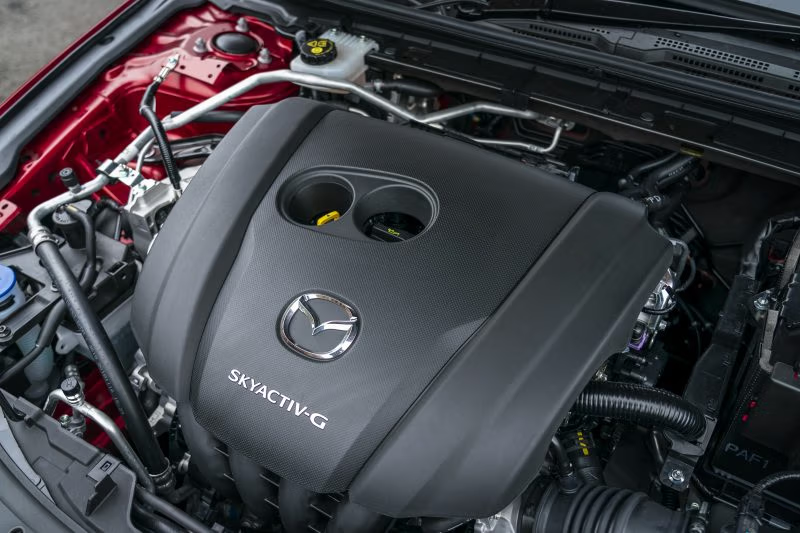
The SKYACTIV-G engine evolution will continue with the introduction of a gasoline-powered variant in the future. Mazda is also working on hybrid systems and plans to introduce more electrified models in North America. By 2030, the company aims to have all its vehicles electrified.
Mazda is working to reduce greenhouse gas emissions by incorporating various technologies that it has developed over the last three decades. It also uses compression ignition to achieve maximum efficiency with light loads. This technology can be used in both gasoline and diesel engines. Mazda’s SKYACTIV-X engine evolution is a testament to this.
The new 2.5 SkyActiv engine features an all-aluminium lineup, chain-driven dual overhead camshafts, VVT, and direct ignition. It replaces the L5-VE engine and shares the same aluminium cylinder block and steel-molybdenum alloy bores. The new engine also has a larger piston stroke.
